UC-6.4 — Enzymatic Hierarchy
Module: 6 – Hierarchical and Flow-based Functional Analysis
Visualization type: Treemap (three-level hierarchical composition)
Primary inputs: BioRemPP results table with enzyme_activity, compoundclass, genesymbol, and compoundname
Primary outputs: Hierarchical partitioning of substrate scope across enzyme activities → chemical classes → genes
Scientific Question and Rationale
Question: Which enzymatic functions are co-annotated with the widest range of unique compounds, how is this co-annotation breadth distributed across different chemical classes, and which specific genes are the primary contributors?
This use case provides a top-down annotation overview of the enzymatic co-annotation landscape in the dataset. It organizes the system into three levels—enzyme activities, compound classes, and genes—and quantifies for each branch how many unique compounds are co-annotated with it. The resulting treemap may highlight broadly co-annotated enzymatic functions, which chemical classes are their main co-annotation context, and which genes contribute the most to this compound co-annotation breadth.
Data and Inputs
- Primary data source:
BioRemPP_Results.xlsx or BioRemPP_Results.csv - Key columns:
enzyme_activity– functional category/label of the enzymatic activitycompoundclass– chemical class/category of the substratesgenesymbol– gene symbol or identifier implementing that activity in at least one samplecompoundname– specific compound name or identifier-
Accepted format: semicolon-delimited text table (
.txtor.csv) -
Hierarchical structure:
- Enzyme Activity (
enzyme_activity) - Compound Class (
compoundclass) - Gene Symbol (
genesymbol)
Analytical Workflow
-
Data Loading
The primary results table (BioRemPP_Results.xlsx or BioRemPP_Results.csv) is loaded from its semicolon-delimited format. -
Hierarchy Definition
A three-level hierarchy is defined: - Level 1:
enzyme_activity - Level 2:
compoundclass(nested within each enzyme activity) -
Level 3:
genesymbol(nested within each compound class) -
Aggregation of Substrate Scope
The data is grouped by each unique(enzyme_activity, compoundclass, genesymbol)path: - for each group, the number of distinct
compoundnameentries is computed (e.g., vianunique()), -
this count represents the substrate scope (number of unique compounds) associated with that gene within that functional and chemical context.
-
Value Propagation for Treemap
The unique compound counts at the lowest level (per gene) are used as the basic values: - higher-level values for
compoundclassandenzyme_activitynodes are obtained by summing the values of all nested nodes, -
this yields total substrate scope at each level of the hierarchy.
-
Rendering
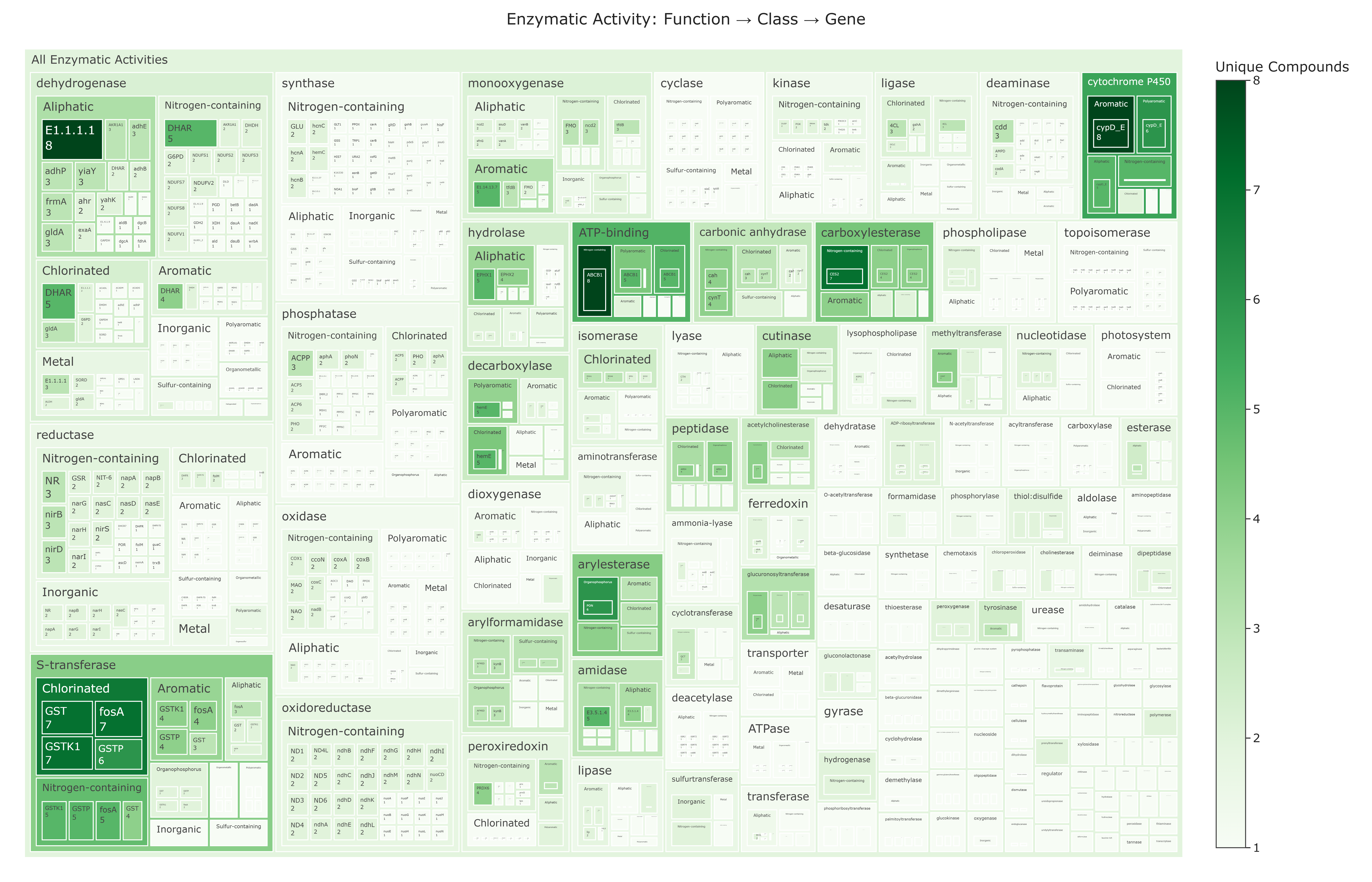
The aggregated data is rendered as an interactive treemap: - each rectangle represents a node in the hierarchy (enzyme activity, compound class, gene),
- the area of the rectangle is proportional to its total unique compound count,
- color is also mapped to the unique compound count to reinforce the visual encoding.
How to Read the Plot
- Nested Rectangles (Hierarchy)
The treemap uses nested rectangles to represent the hierarchy: - Outer rectangles represent enzyme activities (
enzyme_activity), - within each activity, inner rectangles represent compound classes (
compoundclass), -
within each class, the smallest rectangles represent genes (
genesymbol). -
Area (Values) The area of each rectangle is proportional to the total number of unique co-annotated compounds:
- for a gene node, area reflects how many distinct compounds that gene is co-annotated with under that activity–class context,
- for a compound class node, area reflects the sum of unique compounds co-annotated with all genes contributing to that class,
-
for an enzyme activity node, area reflects the full compound co-annotation breadth of that activity across classes and genes.
-
Color Encoding Rectangle color also encodes the unique co-annotated compound count:
- brighter or warmer colors indicate broader compound co-annotation coverage,
-
cooler colors indicate more limited compound co-annotation sets.
-
Interactivity
In the interactive view: - clicking on a rectangle zooms in to that part of the hierarchy,
- hovering displays labels (enzyme activity, compound class, gene) and their associated unique compound counts.
Representative Output
The image below illustrates a representative output generated by this use case using the example dataset.
Click on the image to enlarge and explore details.
Interpretation and Key Messages
- Broadly Co-annotated Enzyme Functions The largest and most intensely colored top-level rectangles may identify enzyme activities with the broadest compound co-annotation coverage:
- these could correspond to broad annotation classes such as oxidoreductases, transferases, or hydrolases that are co-annotated with many different compounds,
-
they may represent annotation-rich enzymatic categories in the dataset.
-
Chemical Class Annotation Breadth within Activities Within a given enzyme activity, the largest compound class rectangles may reveal:
- which chemical classes are most broadly co-annotated with that activity,
-
how compound co-annotation breadth is distributed across chemical space.
-
High-contributing Genes At the lowest level, large gene rectangles may identify broadly co-annotated genes:
- genes co-annotated with many distinct compounds under a given activity–class context,
-
genes with broad compound co-annotation coverage that may be candidates for further investigation.
-
System-Level Annotation Overview Taken together, the treemap can offer a compact annotation overview:
- it may show where compound co-annotation breadth is concentrated across enzyme activities,
- how chemical classes distribute across different enzymatic annotation categories,
- and which genes are most broadly co-annotated within those contexts.
Reproducibility and Assumptions
- Input Format
The analysis assumes a semicolon-delimited table containing: -
enzyme_activity,compoundclass,genesymbol, andcompoundname. -
Value Definition
- The fundamental value driving the visualization is the count of unique compound names per
(enzyme_activity, compoundclass, genesymbol)group. -
Higher-level values are computed as sums of these counts across nested nodes.
-
Interpretation Scope
- Unique-compound count is used as a measure of compound co-annotation breadth; it does not encode enzyme kinetics, expression levels, or in situ activity.
- The treemap should therefore be interpreted as a structural and comparative annotation map of where compound co-annotation breadth is concentrated, guiding more detailed mechanistic or experimental studies rather than replacing them.
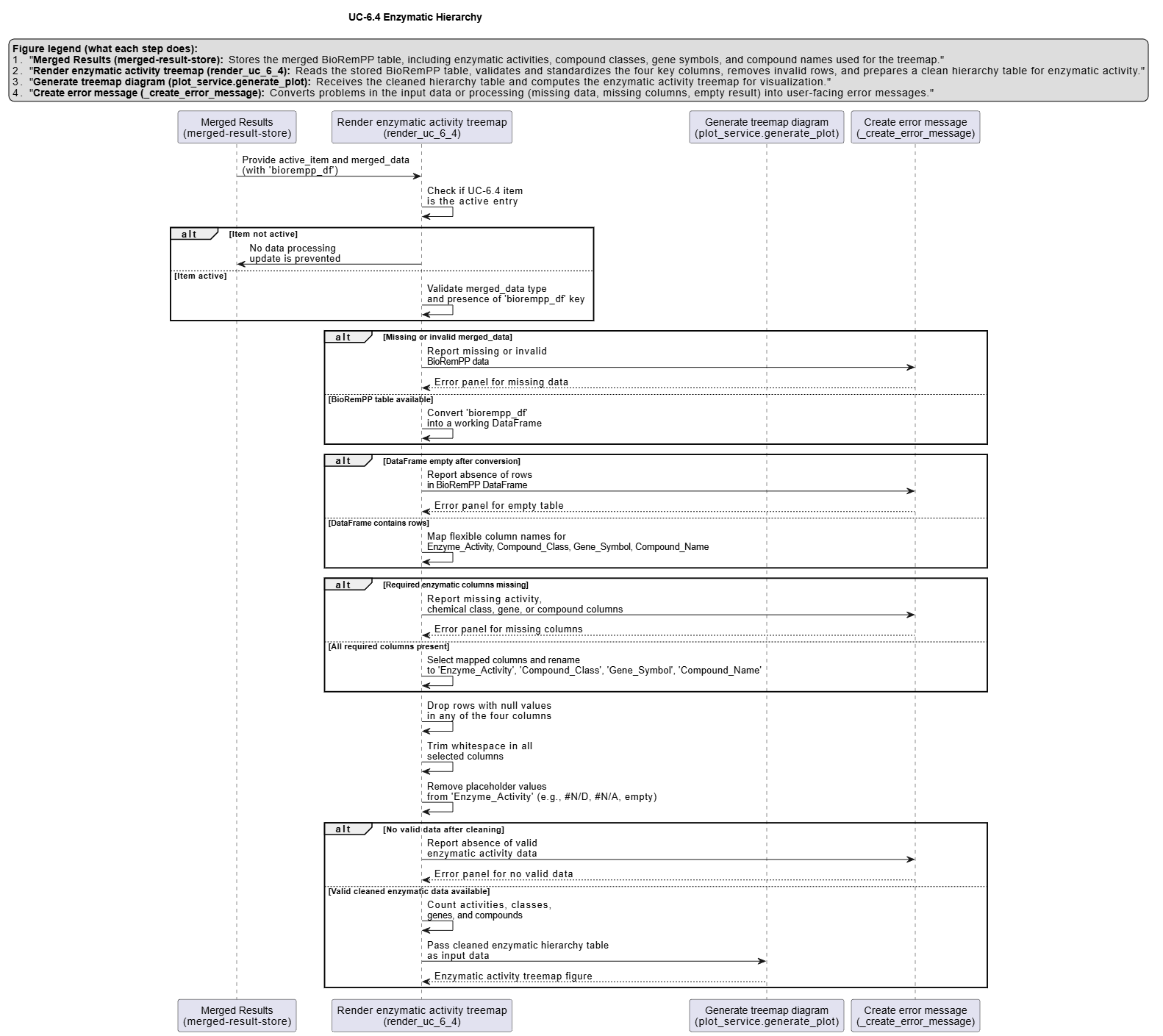
Activity diagram of the use case
Click on the image to enlarge and explore details.