UC-7.6 — Sample Risk Mitigation Breadth
Module: 7 – Toxicological Risk Assessment and Profiling
Visualization type: Interactive treemap (hierarchical breadth of high-risk compound coverage per sample)
Primary inputs: BioRemPP_Results.xlsx or BioRemPP_Results.csv (sample–compound interactions) and ToxCSM.xlsx or ToxCSM.csv (predicted toxicity and categories)
Primary outputs: Per-sample "Risk Mitigation Breadth Profile" across toxicological categories
Scientific Question and Rationale
Question: Which samples have the broadest compound co-annotation coverage, as measured by the variety of distinct high-risk compounds they are co-annotated with within each toxicological category?
This use case characterizes the annotation-level breadth of sample–compound co-annotations for predicted high-risk compounds. The treemap quantifies, for each sample and toxicological category, the number of distinct high-risk compounds that the sample is co-annotated with. The resulting "Compound Co-annotation Breadth Profile" may highlight samples co-annotated with many different hazardous compounds, as well as samples with broad coverage within a particular toxicological domain (e.g., Genomic, Environmental, Organic). Experimental validation is required to confirm any mitigation capacity.
Data and Inputs
- Primary data sources:
BioRemPP_Results.xlsx or BioRemPP_Results.csv– KO annotation data linking samples and compoundsToxCSM.xlsx or ToxCSM.csv– predicted toxicity scores and qualitative labels for compounds- Key columns:
- From
ToxCSM.xlsx or ToxCSM.csv:compoundname– chemical compound nameendpoint/label_*– endpoint-specific toxicity labels (e.g., "High Toxicity", "High Safety")supercategory(derived) – mapped toxicological category (e.g., Genomic, Environmental, Organic)
- From
BioRemPP_Results.xlsx or BioRemPP_Results.csv:sample– identifier for each biological samplecompoundname– compound associated with the sample
- Hierarchy represented in the treemap:
- Level 1: Sample
- Level 2: Toxicity Category (toxicological super-category)
The quantitative value displayed is the count of distinct high-risk compounds per (sample, category) pair.
Analytical Workflow
-
Data Loading and Integration
BothBioRemPP_Results.xlsx or BioRemPP_Results.csvandToxCSM.xlsx or ToxCSM.csvare loaded from their semicolon-delimited formats. -
Risk Filtering in ToxCSM
TheToxCSMdata is reshaped into a long format (one row per compound–endpoint pair) and filtered to keep only interactions where the predicted risk is high. The remaining set defines compounds with relevant predicted toxicity. -
Endpoint-to-Category Mapping
Individual toxicological endpoints are mapped to broader Toxicity Categories (e.g., Genomic, Environmental, Organic) using a predefined lookup, assigning each endpoint to its parent super-category. -
Data Merging
The risk-filtered and categorized ToxCSM data is merged withBioRemPP_Results.xlsx or BioRemPP_Results.csvoncompoundnameto connect: - high-risk compounds,
- their toxicological categories, and
-
the samples known to interact with them.
-
Aggregation for Breadth
The merged dataset is grouped bysampleandToxicity Category. For each(sample, category)combination, the number of distinct compound names is computed (e.g., vianunique()oncompoundname). This count is the breadth metric used in the visualization. -
Rendering as Treemap
The aggregated data is rendered as an interactive treemap: - each Sample is represented as a top-level rectangle,
- within each sample, second-level rectangles represent Toxicity Categories,
- the area of each category rectangle is proportional to the number of unique high-risk compounds covered by that sample in that category.
How to Read the Plot
- Nested Rectangles (Hierarchy)
The treemap uses nested rectangles to encode the hierarchy: - the largest rectangles correspond to Samples,
-
rectangles nested within each sample correspond to Toxicity Categories.
-
Area (Values) The area of each rectangle is proportional to the count of unique high-risk compounds co-annotated with a given
(sample, category)combination. Larger areas indicate broader compound co-annotation coverage. -
Color Encoding
Color is typically used to distinguish Toxicity Categories at the second level, helping users quickly see which risk domains dominate within each sample. -
Interactivity (Zoom and Tooltips)
Interactive behavior typically includes: - clicking on a rectangle to zoom in on a particular sample or category, and
- tooltips showing precise values (sample name, category, and unique high-risk compound count).
Representative Output
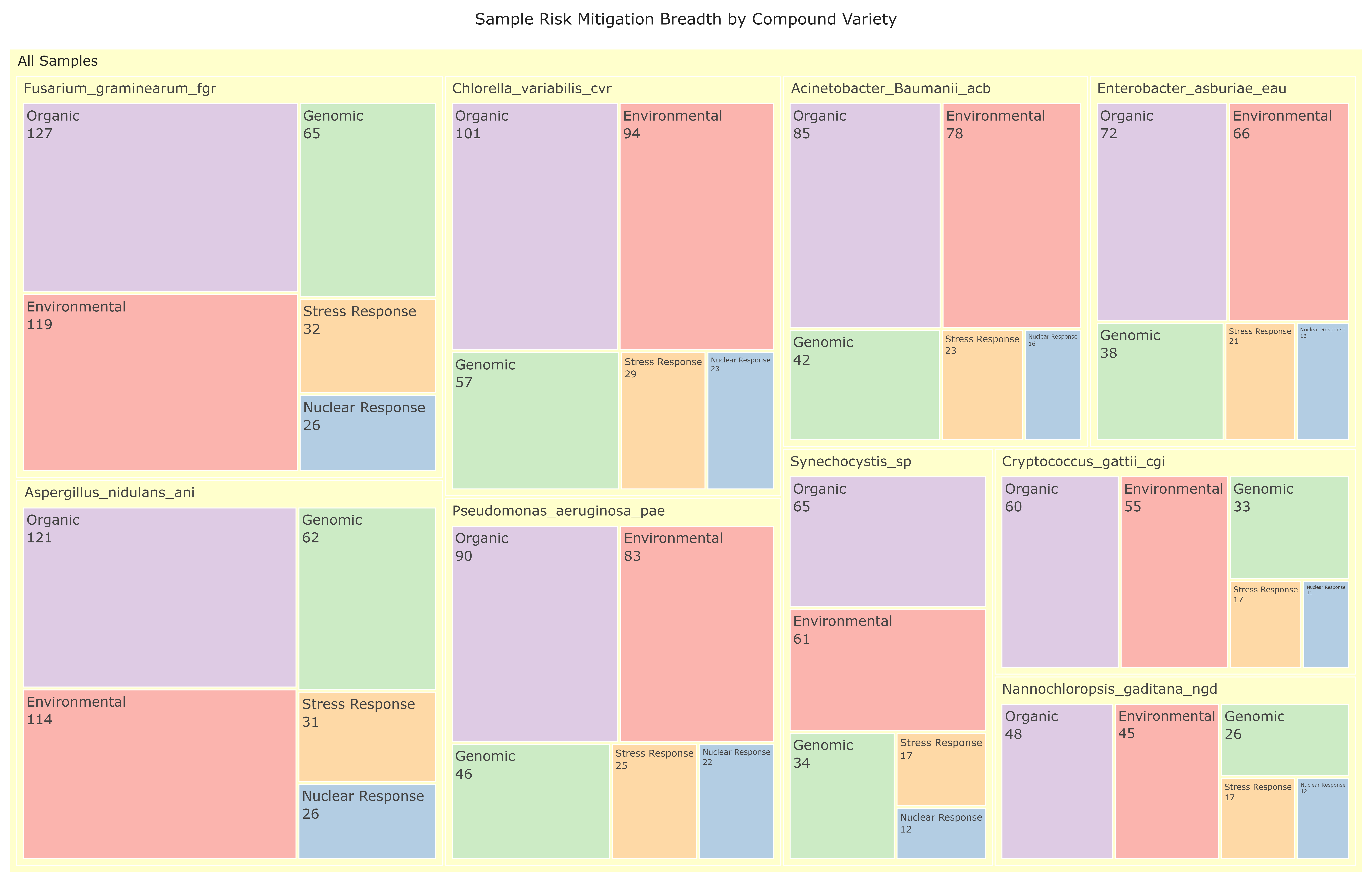
The image below illustrates a representative output generated by this use case using the example dataset.
Click on the image to enlarge and explore details.
Interpretation and Key Messages
-
Samples with Broad Co-annotation Coverage Samples whose top-level rectangles dominate the treemap area are co-annotated with many distinct high-risk compounds across multiple categories. These samples may be candidates for prioritized experimental investigation, though confirmed mitigation capacity requires experimental validation.
-
Category-Specific Annotation Breadth Within a sample, a particularly large rectangle for a single Toxicity Category (e.g., Environmental) may indicate high co-annotation breadth within that domain. Such samples could be relevant candidates for targeted investigation in that specific risk category.
-
Annotation-based Complementarity for Hypothesis Generation The treemap can be useful for identifying complementary annotation profiles across samples. For example:
- a sample with broad Genomic annotation coverage can be compared with one that has broad Organic or Environmental coverage,
-
together, they may represent candidates for hypothetical complementary roles (experimental validation required).
-
Breadth vs. Depth This use case emphasizes breadth of co-annotation coverage—the variety of high-risk compounds co-annotated—rather than depth (e.g., number of KO annotations per compound). It is therefore complementary to analyses that focus on annotation counts and annotation diversity.
Reproducibility and Assumptions
- Input Format
The analysis requires: BioRemPP_Results.xlsx or BioRemPP_Results.csv– semicolon-delimited, containing at leastsampleandcompoundname, and-
ToxCSM.xlsx or ToxCSM.csv– semicolon-delimited, containingcompoundname, toxicity scores, labels, and endpoint metadata. -
Definition of "High-Risk" or "Non-Safe"
Compounds are included in the breadth calculation if they are not labeled as "High Safety" in at least one endpoint. Depending on the project's risk tolerance, this filter can be tightened (e.g., only "High Toxicity") or relaxed. -
Breadth Metric
The visualization uses the count of unique high-risk compound names per (sample, category) as its driving value. Multiple occurrences of the same compound for a given sample–category combination are counted only once. -
Name Consistency and Mapping
Accurate integration relies on consistentcompoundnamefields betweenBioRemPP_Results.xlsx or BioRemPP_Results.csvandToxCSM.xlsx or ToxCSM.csv. Synonyms, salts, or different naming conventions should be harmonized upstream to avoid underestimating breadth. -
Model Dependency
The notion of "risk" is derived from ToxCSM's predictive outputs. The treemap does not directly reflect exposure levels, environmental concentrations, or experimental toxicology; it should be interpreted as a model-informed relative breadth of compound co-annotation coverage.
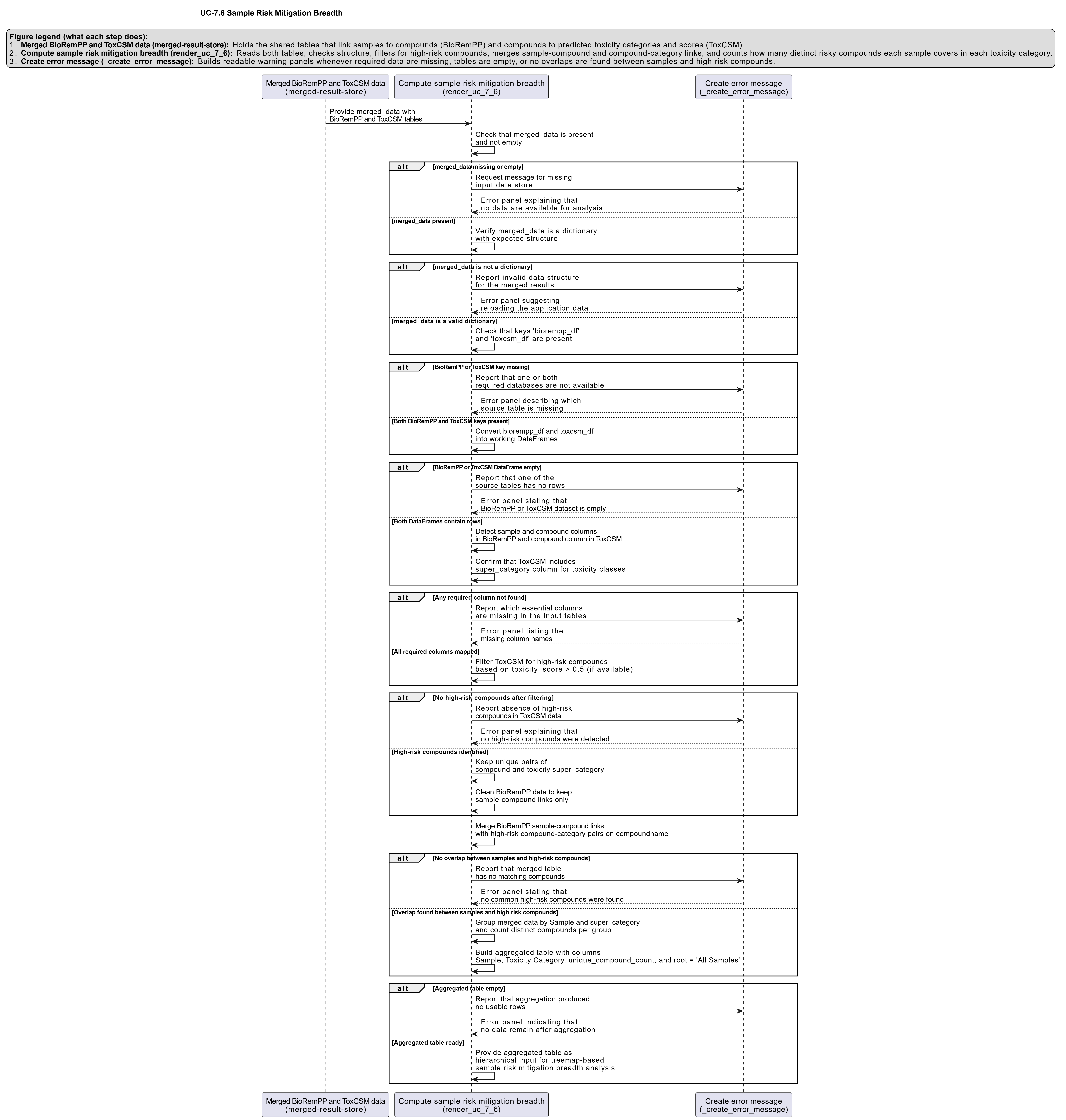
Activity diagram of the use case
Click on the image to enlarge and explore details.